Skip to content
Kansas City Commercial Roofers

Serving Kansas City and nearby areas

TPO vs EPDM for a Commercial Roof in Kansas City, KS

TPO and EPDM are the two most common flat roofs, and the right one depends on your building, so get a free roof inspection and a written price for each option set up the same day you call.

Book a free roof inspection

A few quick answers. A local roofing specialist calls you back the same business day.

Local to Kansas City

We connect property owners in Kansas City and nearby areas, including Fairfax District, Armourdale, Village West, Edgerton, Lenexa and Olathe, with one independent local commercial roofing specialist.

  • Hot summers

    Normal July highs in Kansas City reach about 89 degrees. A white roof stays cooler in the sun than a black one.

  • Cold winters

    Normal January lows sit near 19 to 21 degrees. Both sheets stay flexible in the cold, but seams take strain from the yearly swing.

  • Hail country

    A hazard mapping firm ranked Kansas City, Kansas, eighth among hail-prone metros in the US. Hail resistance belongs in the choice.

What it costs

Typical published ranges for Kansas City. The contractor's written estimate is the price, and the inspection is free.

WorkTypical range
Inspection and written price for each optionSet up through Kansas City Commercial Roofers Free
TPO (white single-ply), installed $450 to $1,400per square
EPDM (black rubber), installed $425 to $1,200per square
Old roof tear-off and disposal $1 to $5per square foot
Seam repair, either system $200 to $1,000

See typical commercial roofing prices in Kansas City

Two good roofs, one right fit

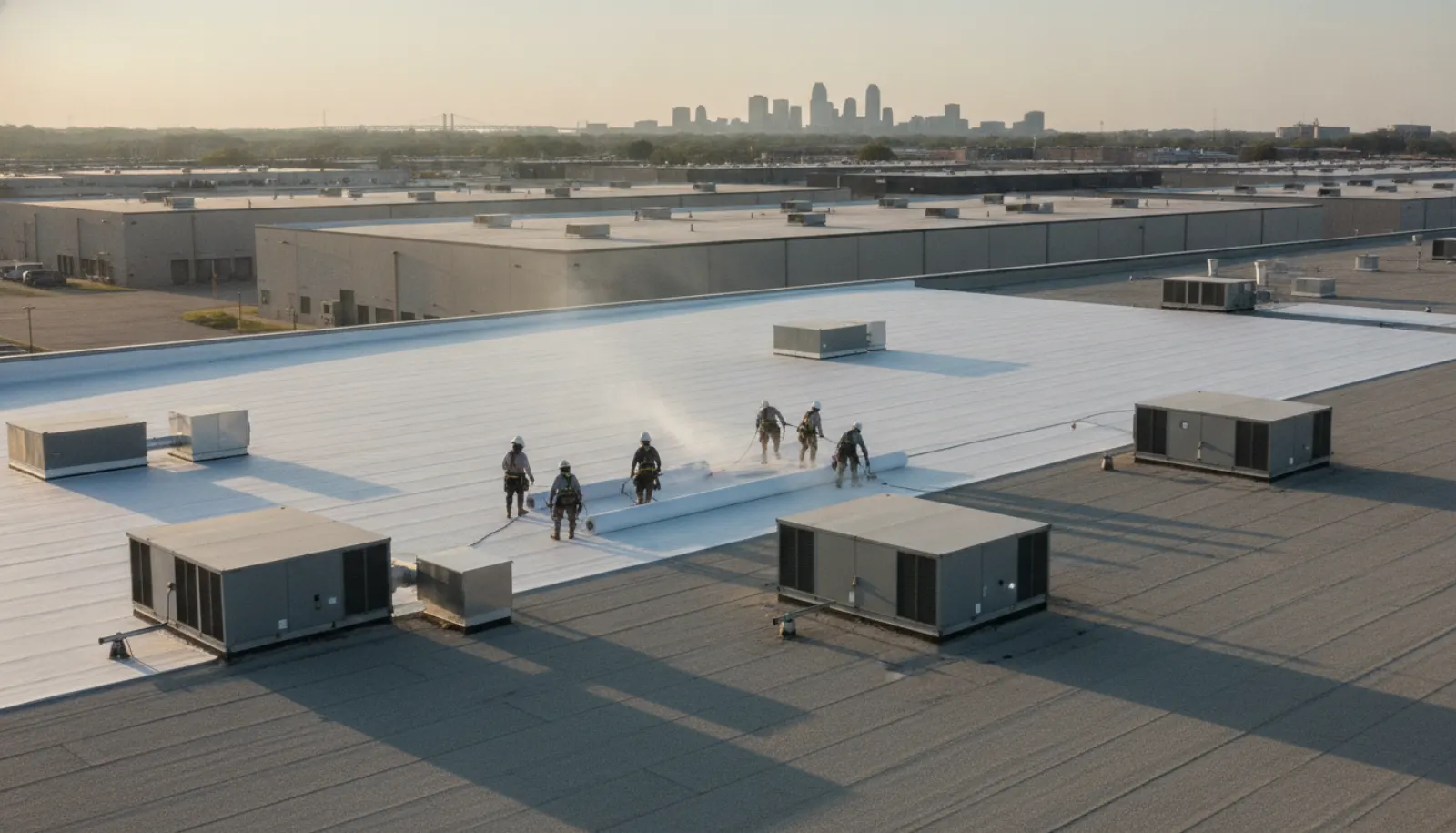
If your flat roof is due for replacement, the bids will likely offer one of two sheets. TPO is a white plastic sheet with heat-welded seams. EPDM is a black rubber sheet with taped seams. Both are proven. Both cover thousands of warehouses, stores and offices in the Kansas City metro.

Neither one is best for every building. The right answer depends on what is under the roof, how much you cool the space, what is on the roof now, and how long you plan to own the building.

What you will be choosing between

Color

TPO is usually white and reflects the sun. EPDM is usually black and soaks it up.

Seams

TPO seams are welded with hot air into one piece. EPDM seams are bonded with tape or glue.

Track record

EPDM has been on roofs for decades. TPO is newer, but it is now one of the most common choices for new low-slope buildings.

Repairs

EPDM patches with tape and primer. TPO repairs need a hot-air welder.

Cost

National guides show the two price ranges overlapping, with EPDM a little lower at the low end.

Heat: Kansas City summers

The National Weather Service puts normal July highs in Kansas City near 89 degrees. A black roof in the sun gets far hotter than the air. A white roof stays much cooler.

That matters most for buildings that cool their top floor: offices, retail, medical and climate-controlled storage. For those, a white TPO roof can cut the cooling load. For a dry warehouse that is barely cooled, the gain is smaller.

Heat also ages a roof. A hot black roof cooks sealants and flashing faster. A white roof that gets dirty loses some of its edge, so it should be kept clean.

Cold: freeze and thaw

Normal January lows here sit near 19 to 21 degrees. Both sheets stay flexible in the cold. The bigger issue is the swing from summer to winter. The sheet grows and shrinks, and the seams take that strain.

Older EPDM roofs seamed with liquid glue had a history of seam failures. Federal researchers at NIST studied it, and the industry moved to seam tape, which holds up far better. TPO's welded seams are strong when done right, and makers tell crews to probe every weld. On either roof, the quality of the seam work is as important as the sheet itself.

Hail: a big factor here

A hazard mapping firm ranked Kansas City, Kansas, eighth among hail-prone metros in the US. So hail belongs in the choice.

An EPDM industry group reports that inspectors found no punctures on three EPDM roofs after a major 2016 North Texas hail storm, with hail of 1 to 3 inches. The same study found two thermoplastic roofs badly damaged by hail under two inches. Keep in mind that the group speaks for EPDM makers, and three roofs is a small sample.

The bigger lesson from hail studies applies to both sheets. Roofs over a hard, high-strength cover board did much better than roofs over soft board. Whichever sheet you choose, ask about the cover board and the sheet thickness. Thicker sheets cost more but take hits better.

Lifespan and cost

Published guides put both TPO and EPDM near 20 to 30 years when well installed and kept up. Hail, drainage, foot traffic and upkeep change that more than the sheet type does.

For price, national cost guides put TPO at about $450 to $1,400 per square installed, and EPDM at about $425 to $1,200. A square is 100 square feet. Tear-off, insulation, cover board, roof size and how many units sit on the roof often move the price more than the sheet does. The table on this page has typical ranges.

Replace or recover

You may not need to tear the old roof off. Building codes can allow one new roof over one old one. They do not allow a new roof over a water-soaked roof or over two or more old roofs. The inspector checks how many layers you have and whether the insulation is dry. If it is, a recover can save the cost of tear-off.

How to decide

Lean TPO

If you cool the top floor, want a white roof, or plan heavy rooftop work where welded seams help.

Lean EPDM

If the building already has EPDM, your crews know it, or you want simple patch repairs.

Either way,

Ask for a high-strength cover board, a stated sheet thickness, and the maker's warranty in writing.

Before the inspection

Gather cooling bills

For the top floor or the whole building.

Find the roof's age

And what is on it now.

List rooftop units

And how often crews service them.

Know your plans

For the building over the next 10 to 20 years.

Call (913) 347-6527 or send the form. Kansas City Commercial Roofers sets up the inspection with one independent local roofing contractor, and you get a written price for the options that fit your building.

Frequently asked questions

Which is cheaper, TPO or EPDM?

They overlap a lot. National cost guides put TPO at about $450 to $1,400 per square installed and EPDM at about $425 to $1,200. The insulation, cover board, tear-off and roof size move the price more than the sheet does.

Which lasts longer?

Published guides put both near 20 to 30 years when well installed and kept up. The install, the sheet thickness, hail and upkeep matter more than the brand name.

Which handles hail better?

An EPDM industry group reports no punctures on three EPDM roofs inspected after a big Texas hail storm. The same study found two thermoplastic roofs badly damaged by hail under two inches. A hard cover board under either sheet helps a lot.

Is a white roof worth it in Kansas City?

Summer highs here run near 89 degrees, and a black roof gets much hotter than the air. A white TPO roof reflects more sun, which can cut cooling load on top-floor space. Buildings with big cooling bills tend to gain more from white.

Can I put TPO over my old EPDM roof?

Sometimes. Building codes do not allow a new roof over a water-soaked roof or over two or more old roofs. If the old rubber roof is dry and it is the only layer, a recover may be allowed. The inspector checks.

Can I repair a TPO or EPDM roof myself?

Small EPDM patches are simple in theory, but most commercial warranties require the maker's repair method and trained crews. TPO repairs need a hot-air welder. Have a crew do it so the warranty holds.

(913) 347-6527 Free inspection